
Breitling marked its 140th anniversary in 2024 with three limited-edition watches built around an important mechanical development: the Manufacture Calibre B19. The Premier, Navitimer and Super Chronomat each received the new perpetual calendar chronograph movement, but their different designs gave the anniversary collection three distinct personalities. Looking back in 2026, the movement remains the most important part of the story. Rather than simply producing commemorative versions of familiar watches, Breitling used the occasion to take its established chronograph technology into more complicated territory.
The introduction of the B19 makes more sense when viewed against the development of the Calibre B01. Since its arrival in 2009, the B01 has provided the foundation for Breitling’s modern manufacture chronographs. Its column-wheel construction and vertical clutch established a platform that could accommodate further functions. The B19 builds on that foundation by combining a chronograph with a perpetual calendar and moon-phase display, creating a movement that demands considerably more coordination than a standard timing mechanism.
For readers following replica watches in the UK, this collection is particularly interesting because the differences are not limited to case materials or dial colours. The three watches share the same mechanical identity, yet each requires a different approach to its case proportions, dial arrangement and external details. Understanding those differences provides a much more useful basis for comparison than relying on broad quality descriptions.
The Calibre B19 Is the Real Anniversary Achievement
A perpetual calendar does considerably more than display the date. An ordinary date mechanism needs correcting at the end of months with fewer than 31 days. A perpetual calendar is designed to account for different month lengths and leap years automatically. Combining this mechanism with a chronograph makes the movement more demanding because the calendar indications and timing functions must operate within the same mechanical architecture.
Breitling had previously explored complicated calendar watches, including its 1461 system, but the B19 represents a different achievement as the brand’s first manufacture perpetual calendar chronograph movement. Based on the B01 architecture, it combines the familiar chronograph mechanism with indications for the day, date, month, leap year and moon phase. Breitling states that, with regular wear or winding, the calendar can operate for nearly a century without major correction.
The dial arrangement is worth examining because it shows how much information the movement has to manage. The date shares the 3 o’clock counter with the 30-minute chronograph display. At 6 o’clock, the month and leap-year indications sit together. The day and small seconds occupy the 9 o’clock register, while the moon phase appears at 12 o’clock. A central hand handles the chronograph seconds. This is a complicated layout, but the different indications remain organised around the main dial rather than being scattered across it.
The movement operates at 4Hz, contains 374 components and 39 jewels, and is COSC-certified. Its approximately 96-hour power reserve is particularly useful in a perpetual calendar watch. The standard B01 offers around 70 hours, so the additional reserve gives the wearer more flexibility if the watch is not worn continuously. This does not remove the need for careful setting if the movement eventually stops, but it reduces the likelihood of having to reset the calendar after shorter periods away from the wrist.
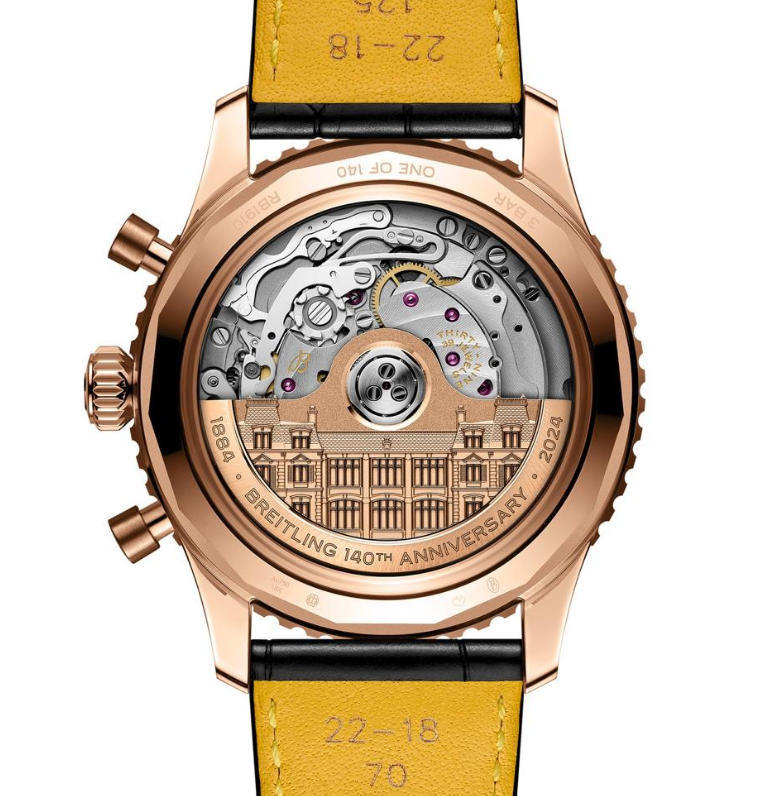
Through the sapphire case back, the anniversary editions reveal another detail that connects the movement with Breitling’s history. The 22K red gold rotor carries an engraving of the historic Montbrillant Manufactory in La Chaux-de-Fonds. Rather than relying entirely on anniversary lettering, Breitling used a part of the movement to reference the place associated with its early watchmaking history. It is a small detail, but one that gives the special editions a more considered identity.
Three Watches With Very Different Personalities
The Premier B19 Datora 42 is the most traditional-looking member of the collection. The Premier first appeared in 1943 as Breitling explored a more refined approach to the chronograph, moving beyond the purely functional appearance of cockpit instruments. The anniversary edition keeps that character through its smooth bezel, black dial and applied gold Arabic numerals. Gold-coloured hands and details provide contrast without making the dial excessively decorative.
Its 42mm 18K red gold case measures 15.6mm thick and is paired with a black alligator leather strap. Although it is the smallest of the three watches by diameter, it is still a substantial chronograph. The calendar displays and additional timing functions occupy considerable space, so the case cannot be judged by diameter alone. What makes the Premier successful is the way its relatively restrained exterior balances the complexity underneath.
The Navitimer B19 Chronograph 43 takes a more recognisable aviation direction. The circular slide-rule bezel remains central to the design, preserving the feature that has defined the Navitimer since its introduction in 1952. Breitling combines it with a 43mm red gold case, a gold-toned sunray-brushed dial and a black outer slide rule. The black alligator strap continues the contrast between the warm dial and the darker bezel.

At 15.62mm thick, the Navitimer is almost as substantial as the Premier, but its visual character is quite different. The slide rule already creates a dense outer scale, while the perpetual calendar adds several more indications inside the dial. This makes spacing and legibility particularly important. The challenge is to introduce the B19 without losing the familiar Navitimer appearance.
Its 30-metre water-resistance rating also reflects the watch’s character. The Navitimer is primarily an aviation-inspired chronograph rather than a dedicated water sports watch. Its identity comes from the slide rule, dial arrangement and mechanical functions, not from a high water-resistance specification.
The Super Chronomat B19 44 is the sportiest of the three. The Chronomat has a different history from the Premier and Navitimer, having been introduced in 1983 as the official watch of the Italian aerobatic team Frecce Tricolori. Its distinctive raised bezel rider tabs, substantial case and chronograph layout have remained important parts of its identity.
The anniversary version uses a 44mm 18K red gold case with black ceramic elements, a rotating bezel and screwed pushers. It is paired with a black rubber strap inspired by the Rouleaux bracelet design. At 15.35mm thick, it remains a large watch, but its combination of ceramic, gold and rubber gives it a more contemporary sports-watch appearance than the other two editions.
The most distinctive feature is the openworked sapphire dial, which allows parts of the B19 mechanism to be seen beneath the calendar indications. This gives the Super Chronomat a more technical appearance, although the displays remain sufficiently defined to retain their purpose. It is also the version where the relationship between the visible movement and the dial layout becomes most important.
All three anniversary watches were limited to 140 pieces and use 18K red gold cases, but they are not simply different sizes of the same design. The Premier is relatively formal, the Navitimer remains closely connected to aviation, and the Super Chronomat puts its mechanical character into a more assertive sports-watch setting. That distinction is what makes the collection more interesting than a conventional group of anniversary editions.

What the B19 Collection Means for Replica Watch Comparisons
Two years after the anniversary, the B19 remains the strongest reason to revisit these watches. The limited production numbers and red gold cases give the collection its commemorative appeal, but the movement is what makes it technically significant. Combining a perpetual calendar with a chronograph is not simply a matter of adding more markings to the dial. The underlying mechanism has to manage several functions accurately while maintaining the operation of the timing system.
This is particularly relevant when examining Breitling replica perpetual calendar watches. A dial showing the day, date, month and moon phase does not necessarily contain a genuine perpetual calendar mechanism. Some versions may use simpler calendar systems, while others may reproduce the appearance of the indications without matching their actual operation. The distinction between a convincing display and a correctly functioning complication should not be overlooked.
The same applies to the chronograph. The original B19 uses a column wheel and vertical clutch, and its 96-hour power reserve and COSC certification are specific characteristics of the genuine manufacture movement. These specifications should not automatically be attributed to a replica simply because the case back carries similar engravings or the dial displays the same functions.
The exterior differences are equally important. A Premier comparison should concentrate on its smooth bezel, applied numerals and balanced black dial. The Navitimer requires much closer attention to the slide-rule markings and the spacing of its internal displays. The Super Chronomat brings different challenges through its ceramic bezel elements, rider tabs and openworked sapphire dial. Each reference has its own proportions, so treating the three as interchangeable Breitling designs would miss the details that define them.
Material descriptions also need to be treated carefully. The original anniversary watches use 18K red gold cases, while the Super Chronomat incorporates black ceramic components. A similar colour or polished finish does not establish that another watch uses the same materials. Water resistance is another specification that should never be transferred from the genuine reference to a replica without independent testing.
Terms such as AAA, 1:1 and super clone are widely used in the replica market, but they are not independent technical certifications. They do not establish whether a calendar mechanism is genuinely perpetual, whether the chronograph uses the same architecture or whether the case and bracelet reproduce the original construction accurately. Looking at the actual functions and individual design details provides a more meaningful comparison.
Readers interested in other models can find further coverage in our Breitling replica watches section, including articles on the Navitimer, Superocean, Chronomat and other collections.
Breitling’s 140th anniversary collection is ultimately remembered for more than its three limited-edition gold cases. The Premier, Navitimer and Super Chronomat each offer a different interpretation of the brand, but the Calibre B19 is what connects them. It takes the chronograph expertise that has shaped Breitling for generations and combines it with a genuinely more complicated calendar mechanism. Viewed in 2026, that is the lasting achievement of the collection, and the reason these three watches remain worth examining beyond their anniversary status.
