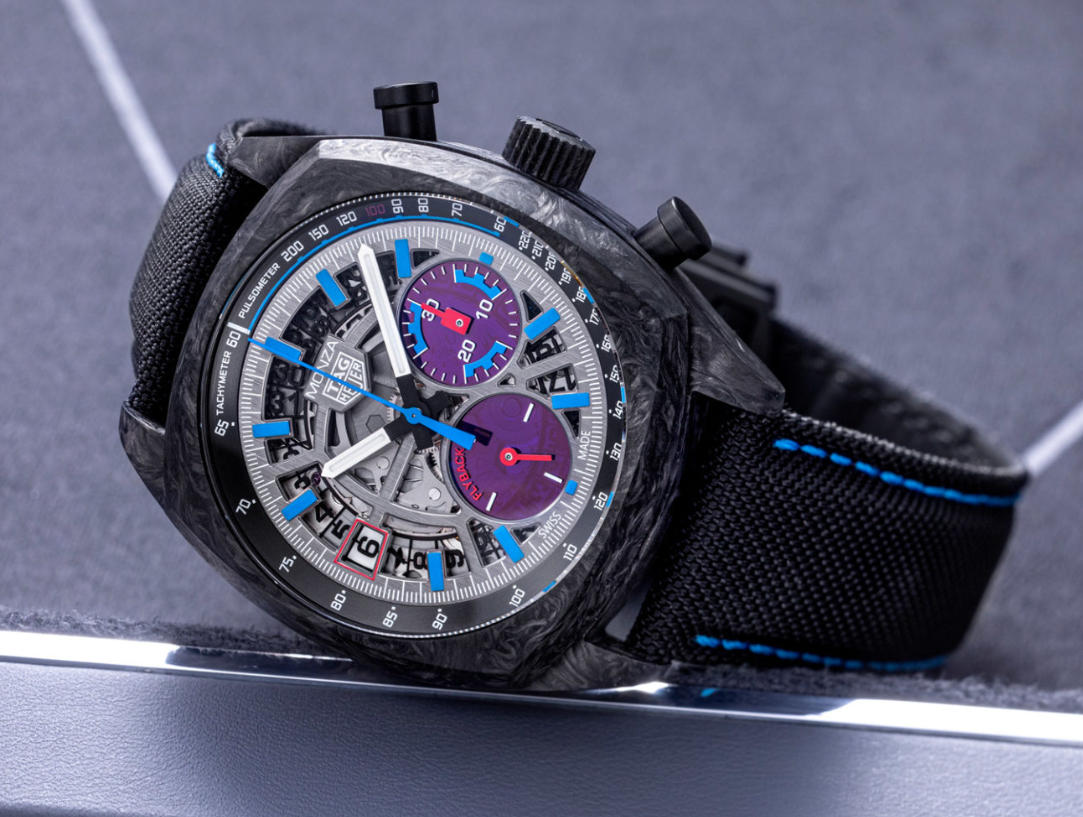
The TAG Heuer Monza has always occupied a slightly unusual place in the brand’s catalogue. It has the racing history, the recognisable name and the connection with one of motorsport’s most famous circuits, yet it has never had quite the same mainstream identity as the Carrera or Monaco.That is partly what makes the modern Monza Flyback Chronometer interesting. Rather than producing another careful recreation of a 1970s watch, TAG Heuer used the name as a starting point for something much more contemporary: a 42mm carbon chronograph with an open dial, strong red and blue accents and a COSC-certified flyback movement.For readers following replica watches and modern watch design in the UK, it is also an unusually useful model to study. A conventional steel chronograph can sometimes be imitated reasonably well through dimensions, dial printing and bracelet finishing alone. The Monza asks far more of a replica because so much of its identity depends on material, depth and construction.
The Monza Name Comes With Plenty of History
The original Heuer Monza appeared in 1976, following Ferrari’s successful 1975 Formula One season. That historical connection matters, but it is easy to lean on it too heavily.The modern Monza Flyback is not really trying to look like a preserved racing chronograph from the seventies.There are familiar cues, including the general cushion-shaped case and motorsport character, but the overall impression is much more technical. Carbon replaces the black-coated metal associated with the early Monza, the dial is opened up, and the movement is visible through the structure rather than hidden behind a conventional face.That decision makes the watch more interesting than a straightforward anniversary reissue. TAG Heuer already knows how to reproduce its archive faithfully. Here, the company chose to ask what a Monza might look like if the name were being developed for the present rather than recreated from the past.
The 42mm Carbon Case Does More Than Save Weight
On paper, 42mm sounds fairly large, particularly for anyone accustomed to vintage Heuer chronographs. In practice, the important point is not simply the diameter but the material surrounding it.The Monza uses a carbon case and fixed carbon bezel. Carbon gives the surface a visual texture that conventional polished or brushed steel cannot reproduce, and each area catches light differently rather than presenting one uniform metallic finish.It also keeps the watch relatively light for a modern automatic flyback chronograph.That combination matters because a thick sports chronograph can quickly feel top-heavy. Using carbon changes the balance of the watch before the wearer even begins considering the design.This is one reason a 42mm carbon TAG Heuer Monza replica needs to be assessed differently from a normal steel TAG Heuer copy. Matching the diameter is the easy part. The harder question is whether the material has the correct density, texture and irregular visual character.Cheap moulded composite can look flat or plasticky under direct light. The genuine watch relies on carbon not just as a technical specification but as part of its visual identity.
The Dial Is Busy, but Deliberately So
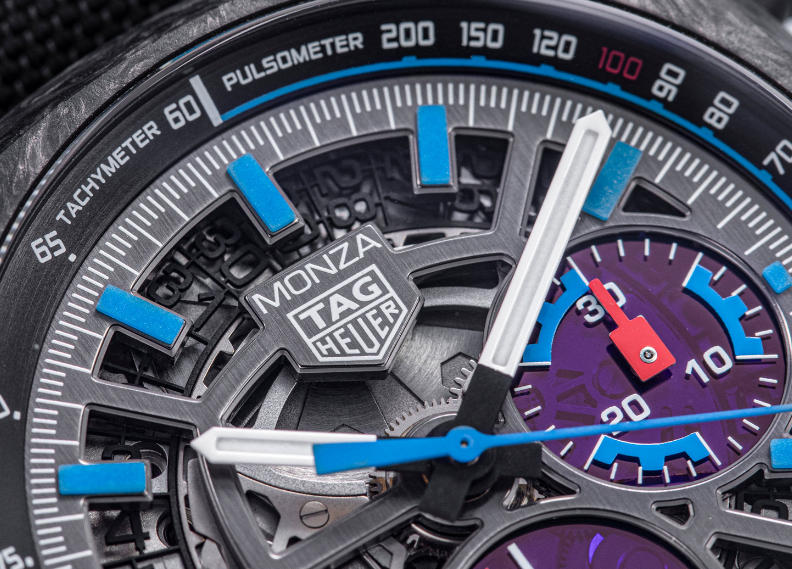
If the case establishes the modern character, the dial finishes the job.The Monza does not have the clean, restrained face of a traditional Carrera. Its centre is open-worked, the outer area carries timing scales, and contrasting blue and red details break up an otherwise dark composition.There is a lot to look at.That could easily have made the watch unreadable, but TAG Heuer has used colour to separate functions rather than simply adding decoration.The translucent blue sapphire counters are particularly important. They allow components underneath to remain partly visible while still creating enough separation for the chronograph indications to be read at a glance.White elements provide another layer of contrast, while the red details bring back the racing character without turning the entire dial into an obvious motorsport graphic.For me, this is where the watch becomes more convincing than its specification sheet suggests. In a photograph it can initially seem over-designed. Look at the individual layers, however, and most of them serve a purpose.
The Skeletonised Date Is Easy to Miss
One of the less obvious details is the way the date has been incorporated into the open dial.On many skeletonised watches, adding a conventional date aperture can look awkward because a solid date wheel suddenly appears behind an otherwise open construction.The Monza handles this more carefully.The date mechanism remains visually integrated with the dial, rather than looking like an unrelated complication inserted afterwards. It is exactly the sort of small feature that becomes important when comparing the genuine watch with a replica.A TAG Heuer Monza skeleton dial replica comparison should therefore look beyond whether the openings are approximately the correct shape. The depth of the dial, positioning of components, date presentation and spacing around the subdials matter just as much.A flat plate printed to resemble an open-worked structure may look acceptable in a product photograph but tends to become obvious once viewed from an angle.
The Flyback Function Is More Than a Name on the Dial
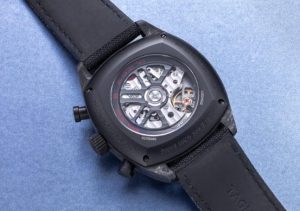
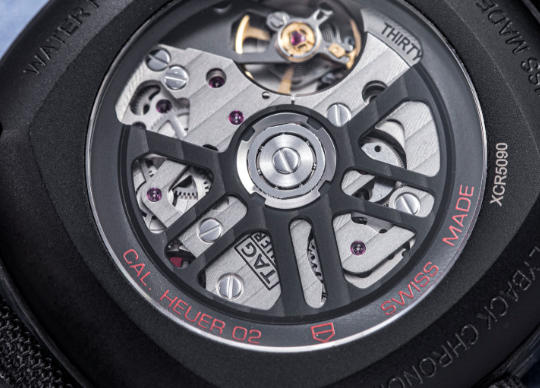
Inside the genuine Monza is TAG Heuer’s automatic Calibre TH20-12 COSC Flyback.The flyback function allows the chronograph to be reset and restarted immediately while it is already running. On a conventional chronograph, timing another interval normally requires stopping the chronograph, resetting it and then starting it again.With a flyback, that sequence can be performed in a single action.It is a complication with obvious historical relevance to aviation and motorsport, where consecutive intervals sometimes need to be timed without delay. Whether most owners actually use it regularly is another question, but mechanically it gives the Monza more substance than a purely cosmetic racing edition.The movement operates at 4Hz and offers approximately 80 hours of power reserve. It is also COSC certified.These details are particularly important in the replica market because the words “flyback” and “chronometer” are sometimes treated as visual features rather than mechanical ones.A genuine COSC certified TAG Heuer flyback chronograph movement represents a set of actual functions and performance criteria. A replica with the same text on the dial does not automatically reproduce those characteristics.
Where a Replica Version Would Be Most Difficult to Get Right
If a factory were trying to reproduce this Monza convincingly, I would inspect four areas before worrying about tiny engraving differences.The first would be the carbon case.A good version should not merely be black. It needs the uneven visual pattern and lightweight feel associated with the genuine material. Case geometry also matters because the Monza combines a cushion-like overall shape with modern surfaces rather than using a simple round sports-watch case.The second area would be dial depth.The genuine watch has multiple visual levels, transparent counters and open sections. Those layers create shadows and reflections that are difficult to imitate with a shallow decorative dial.Third would be the chronograph operation.If a watch is presented as a Monza Flyback but uses an ordinary start-stop-reset chronograph mechanism, the most important complication has not really been replicated.Finally, I would check the colours.The blue, red, black and white elements look simple in isolation, yet the balance between them is quite specific. Too much saturation in the blue counters or overly bright red printing can make the watch feel much cheaper than the original.These small construction details on a high quality Monza replica matter considerably more than marketing terms such as “AAA” or “1:1”, neither of which provides a recognised technical standard for watch quality.
The Strap Suits the Watch Better Than a Bracelet Would
TAG Heuer pairs the carbon case with a black textile strap and folding clasp.That may sound like the least interesting part of the watch, but it helps keep the design coherent. A polished steel bracelet would introduce a visual weight that does not suit the carbon case, while a conventional glossy leather strap could make the watch feel unnecessarily formal.The textile construction instead continues the technical character without competing with the dial.Replica buyers often focus heavily on the watch head and treat the strap as replaceable, but on this particular reference the strap contributes noticeably to the overall balance. Its thickness, flexibility and relationship with the lugs should therefore be part of any meaningful comparison.
The Monza Is Not Trying to Be a Monaco
TAG Heuer has several racing chronographs, and that sometimes makes it difficult to understand where the Monza belongs.The Carrera is generally cleaner and more versatile. The Monaco has one of the most recognisable case designs in modern watchmaking. The Formula 1 collection occupies a more accessible and openly sporting position.The Monza sits somewhere else.It feels more experimental.Rather than depending entirely on the shape of a historical model, this version combines a heritage name with materials and construction that would have been impossible on the original.That makes it less immediately recognisable than a Monaco, but arguably gives it more freedom.Readers comparing related models can browse the TAG Heuer Monza replica watches section for further Monza-specific coverage rather than treating every TAG Heuer racing chronograph as interchangeable.
What UK Buyers Should Actually Compare
For UK readers looking at replica versions online, the most useful approach is to ignore the large quality labels on a seller’s page and compare visible, testable details instead.Start with the case dimensions and overall shape. Then inspect the carbon texture in several lighting conditions rather than relying on one studio photograph.Move to the dial and look at the spacing between the counters, outer scales, hour markers and open sections.Check whether the chronograph actually performs a flyback reset while running.Then consider the strap, clasp and the way the watch sits on the wrist.This kind of UK TAG Heuer Monza Flyback replica buying comparison is much more informative than deciding quality from a factory nickname or seller description alone.It is also important to keep the distinction clear: a replica is not manufactured, certified or warranted by TAG Heuer. References to the genuine watch in this article are used as a design and technical benchmark for comparison.
A Better Monza Because It Is Not Too Faithful
The most interesting thing about the Monza Flyback Chronometer is that TAG Heuer did not allow nostalgia to control the entire project.The historical link is still there. The racing identity remains obvious. Even the case outline gives a nod to previous generations.But this is not a watch pretending that the last fifty years never happened.Carbon construction, an open-worked dial, translucent sapphire counters and a modern flyback movement move the Monza into a very different space from the original model.That will not appeal to everyone, particularly collectors who prefer small, faithful vintage reissues. It does, however, give the watch a reason to exist alongside the Carrera and Monaco rather than simply repeating what those collections already do well.From a replica-watch perspective, it is equally revealing. The Monza demonstrates why copying the outline of a luxury watch is only the beginning. Carbon texture, dial depth and genuine flyback operation are much harder to reproduce than a logo or familiar case shape.And on this particular TAG Heuer, those difficult details are exactly where most of the character lives.
Author
