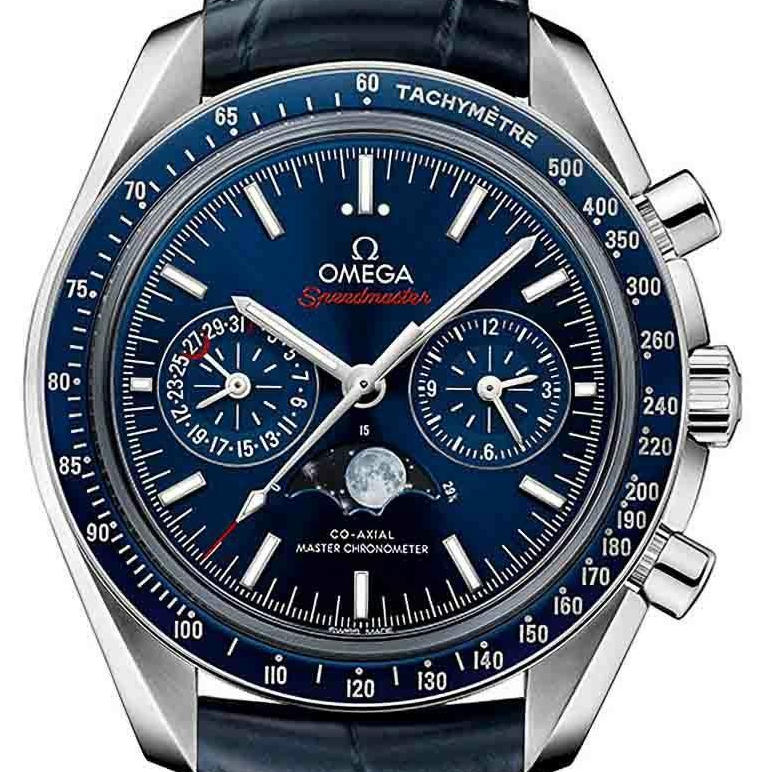
The Omega Speedmaster Moonphase Master Chronometer belongs to a part of the Speedmaster story that is easy to overlook. It arrived in 2016, at a time when Omega was expanding Master Chronometer certification across more of its collection and becoming increasingly confident about moving the Speedmaster beyond the familiar Moonwatch formula. Ten years later, that context matters more than the language used when the watch was first released.
By 2026, the Speedmaster family has become broader rather than narrower. The traditional Moonwatch still anchors the collection, but Omega has continued to experiment with different case sizes, materials, dial layouts and movements around it. That makes the 44.25mm Moonphase easier to understand today. It was never supposed to replace the Moonwatch or offer a more historically faithful version of it. It was Omega taking the same basic Speedmaster identity and seeing how far it could be pushed toward a more complicated, contemporary chronograph.That difference is visible almost immediately. The case is larger, the movement is automatic, the dial uses two main registers instead of the classic three, and the moon-phase display gives the lower half of the watch a completely different visual weight. Yet the familiar twisted lugs, tachymeter bezel and broad chronograph proportions still make it recognisably part of the Speedmaster family.
For readers following replica watches in the UK, that combination makes the watch particularly useful for comparison. A simple watch can sometimes hide inaccuracies because there are fewer components competing for attention. The Speedmaster Moonphase does the opposite. The case profile, bezel, subdial spacing, date display, lunar disc and movement all have to feel coherent. Matching only the general silhouette is not enough.
The Dial Does Most of the Work
The blue dial is what gives this generation much of its character, but the real strength is not the colour alone. It is the way Omega organised several functions without allowing the face to become visually chaotic. The chronograph hours and minutes share the register at 3 o’clock, while running seconds and the pointer date occupy the register at 9. The moon-phase display then sits at 6 o’clock, giving the lower half of the dial a clear focal point.That arrangement gives the watch a sense of symmetry that is not obvious from a list of specifications. There is a lot happening, but the dial still feels balanced because the two main registers carry several functions between them. The centre remains relatively open, the hands have room to move, and the moon-phase display does not have to fight three conventional chronograph counters for attention.
This is where the watch begins to separate itself from the standard Moonwatch rather than simply looking like a larger variation of it. The classic Speedmaster Professional has an almost functional austerity. Its charm comes partly from the fact that very little is decorative. The Moonphase is more polished, more layered and more obviously designed as a modern luxury chronograph. It uses the same family language but with a very different tone.The moon itself is one of the few decorative features that genuinely earns its place. Instead of using a simple stylised lunar disc, Omega created a highly detailed representation of the Moon with a tiny astronaut footprint placed on the surface. It is a small detail, and most owners will rarely study it closely, but that restraint is exactly why it works. The reference to the Speedmaster’s lunar history is present without turning the entire dial into an anniversary graphic.
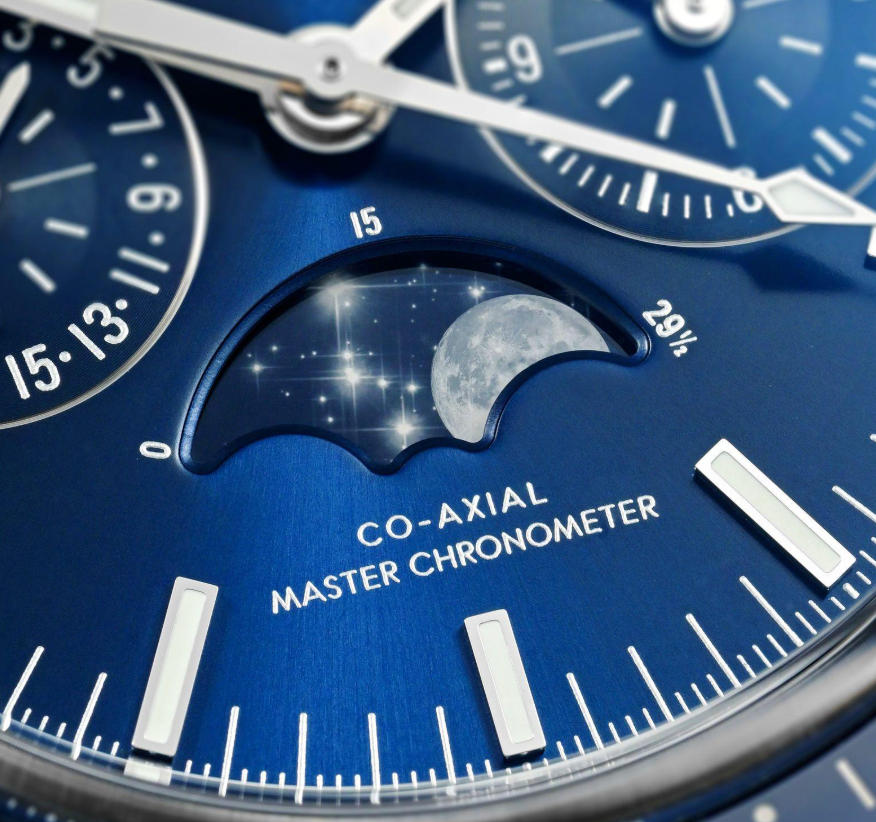
On an Omega Speedmaster Moonphase replica watch, this is one of the easiest areas to judge badly and one of the hardest to reproduce well. A factory can copy the basic crescent opening and print a moon on a dark disc, but the genuine watch relies on depth, surface detail and proportion. If the moon is too bright, too flat or positioned incorrectly within the aperture, the effect becomes noticeably different.The date display deserves just as much attention. Omega avoided a conventional rectangular date window and instead placed the date scale around the running-seconds register at 9 o’clock. A dedicated pointer indicates the date while the seconds hand works within the same subdial. It is a neat solution because the calendar function is present without interrupting the centre of the dial.
That neatness also makes mistakes easier to see. The length of the date pointer, the spacing of the numerals and the relationship between the two hands all need to be correct. A replica can contain every function and still look wrong simply because the subdial proportions are slightly off.The bezel is another area where older descriptions of this watch often become confused. The steel model uses a blue ceramic bezel with a Liquidmetal tachymeter scale. Liquidmetal is not the material used for the dial itself. That may sound like a minor distinction, but it changes what should actually be examined when comparing the original with a replica. The bezel should have a controlled ceramic gloss and sharply defined tachymeter markings rather than looking like painted metal.
The Large Case Is Part of the Design Rather Than an Accident
The 44.25mm case remains one of the most divisive aspects of this generation. At nearly 17mm thick, it is substantial even by modern chronograph standards. Anyone coming from a vintage Speedmaster or the 42mm Moonwatch Professional will immediately notice the extra volume.
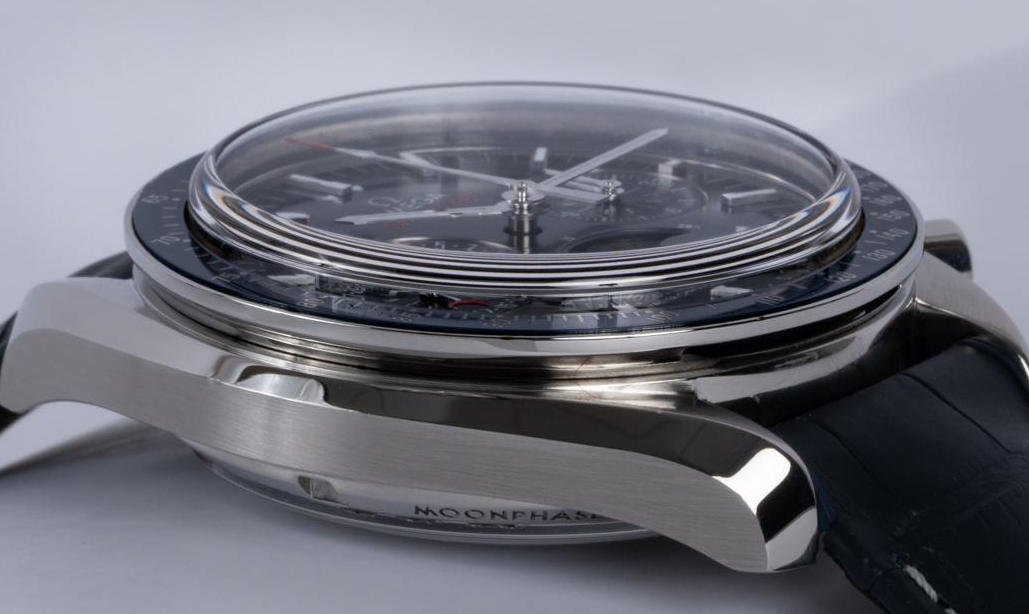
It is easy to criticise those dimensions in isolation, but the watch makes more sense when the functions are considered together. Omega had to accommodate an automatic chronograph movement, a moon-phase mechanism, a date display and two large multifunction registers while still keeping the dial legible. A much smaller case could have made the same layout feel compressed.The size therefore feels deliberate rather than fashionable. There is enough distance between the subdials, bezel and hour markers for the dial to breathe. The moon-phase aperture also has sufficient room to show meaningful detail rather than becoming a tiny decorative window.That does not mean the watch will suit every wrist. It will not. The thickness in particular gives it a very different presence from the traditional Moonwatch. But judging this Speedmaster only by whether it fits the proportions of the Professional misses the point. It belongs to a different branch of the family.
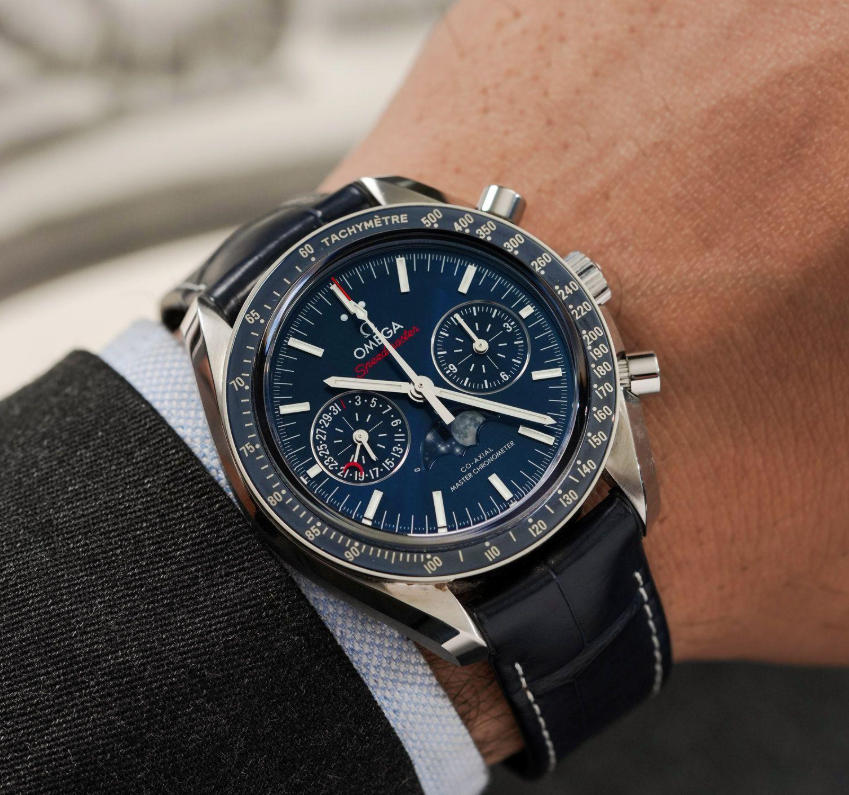
This is also why a 44.25mm Omega Speedmaster Moonphase replica should not be judged by diameter alone. A factory can reproduce 44.25mm relatively easily. The harder part is getting the rest of the geometry right. Mid-case thickness, bezel height, lug curvature, crown position and pusher length all affect the profile of the watch.A front-facing photograph can hide many of these problems. From directly above, a slightly over-thick replica may still appear convincing. Viewed from the side, the differences become much more obvious. If the bezel sits too high or the middle case is too deep, the watch can feel heavier and less integrated than the original.The twisted lugs are equally important because they provide the strongest visual connection to the wider Speedmaster family. They need to flow naturally from the case rather than looking like separate straight extensions. Poor finishing around this area can make an otherwise accurate replica look generic.Colour balance is another detail worth watching. The dial, ceramic bezel and strap all belong to the same blue family, but they do not present the same surface or exact tone. The dial reacts differently to light from the ceramic bezel, while the strap adds yet another texture. On weaker replicas, these elements can look as though they were matched to one colour reference rather than designed as separate materials.
The Movement Is What Keeps the Watch Relevant
The Calibre 9904 is arguably the reason the watch still feels technically credible ten years later. It is an automatic Co Axial Master Chronometer movement with a 4Hz frequency and around 60 hours of power reserve, but the more important point is how much it combines within one architecture. Chronograph hours and minutes, running seconds, pointer date and moon phase all have to work together rather than appearing as unrelated modules on the dial.
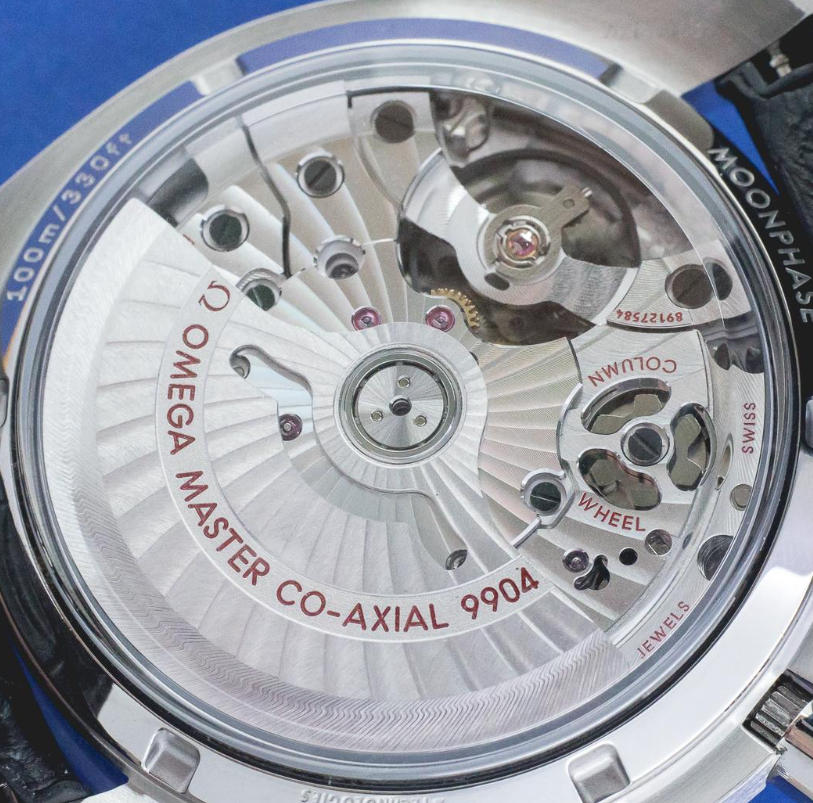
The movement also represents a particular period in Omega’s development. By the middle of the 2010s, anti-magnetic performance and Master Chronometer testing were becoming central to the brand’s technical identity. The Calibre 9904 uses Omega’s Co Axial escapement together with a silicon balance spring and is designed to withstand magnetic fields reaching 15,000 gauss.Those terms are worth keeping separate because watch writing often blurs them together. The watch does not use a “silicon escapement”. The escapement is Co Axial; the balance spring is silicon. The distinction is small to a casual reader, but accuracy in details like this matters, particularly on a site that increasingly focuses on explaining how watches actually differ rather than repeating manufacturer language.The movement is visible through the sapphire case back and finished with Omega’s familiar Geneva waves in arabesque. The related Calibre 9905 used in precious-metal versions receives different decorative treatment, including an 18K Sedna Gold rotor and balance bridge, while the 9904 uses rhodium-plated components.
This is where replica marketing language becomes less useful. A movement may be described as a clone simply because its rotor and bridges have been decorated to resemble the original. That does not necessarily mean the underlying architecture, chronograph system or calendar functions are the same.For a serious Calibre 9904 replica movement comparison, the first question should therefore be functional rather than cosmetic. Does the chronograph operate correctly? Do the combined hour and minute recorder behave as expected? Does the pointer date line up properly? Does the moon phase advance consistently? Only after those questions are answered does decorative similarity become especially meaningful.
The Moonphase therefore exposes a weakness that simpler replica watches can sometimes hide. On a basic three-hand watch, a reasonably accurate case and dial can create a convincing first impression even when the movement underneath is completely different. On this Speedmaster, the functions are too closely tied to the design for the movement to be ignored.That is also why this generation feels more interesting in 2026 than it did when judged only as a new release in 2016. At launch, much of the discussion naturally focused on the Master Chronometer label, the unusual moon display and the large case. With ten years of distance, it is easier to see that the watch represented a broader idea about what Omega believed the Speedmaster could become.The Moonwatch has continued to occupy the historical centre of the collection, while newer Speedmaster references have explored different sizes, materials and dial treatments around it. The Moonphase fits naturally into that wider picture. It is not the most faithful Speedmaster, and it was never meant to be.
For UK readers considering replica versions, that distinction is useful. The aim should not simply be to find something that resembles a blue Speedmaster. The moon-phase detail, pointer-date alignment, case profile, ceramic bezel and chronograph functions are what define this particular reference. If those areas are weak, the watch loses much of the character that separates it from an ordinary chronograph.It is also worth being cautious with descriptions such as AAA, 1:1 or super clone. None of those labels guarantees that the dimensions, materials or movement functions match the reference being copied. Looking at photographs from several angles and checking the actual behaviour of the complications usually tells you more than the grade printed in a product title.Readers who want to place this model alongside other generations can browse the Omega Speedmaster replica watches section. Comparing it with the Moonwatch, older automatic Speedmasters and newer references makes the Moonphase’s position in the collection much clearer.
A decade later, the strongest thing about this Speedmaster is that it no longer needs to be judged as a novelty. The size remains large and the design is too complicated for anyone looking for the simplest expression of the Speedmaster idea. But those characteristics now feel intentional rather than excessive. The watch took a familiar chronograph and gave it a different mechanical and visual personality without removing the details that make a Speedmaster recognisable.That same complexity is what makes the replica versions revealing. Reproducing the outline is straightforward. Getting the proportions, dial depth, moon display, date system and movement behaviour to work together is not. On the Speedmaster Moonphase, the difference between looking familiar and feeling convincing lies in those smaller details.
